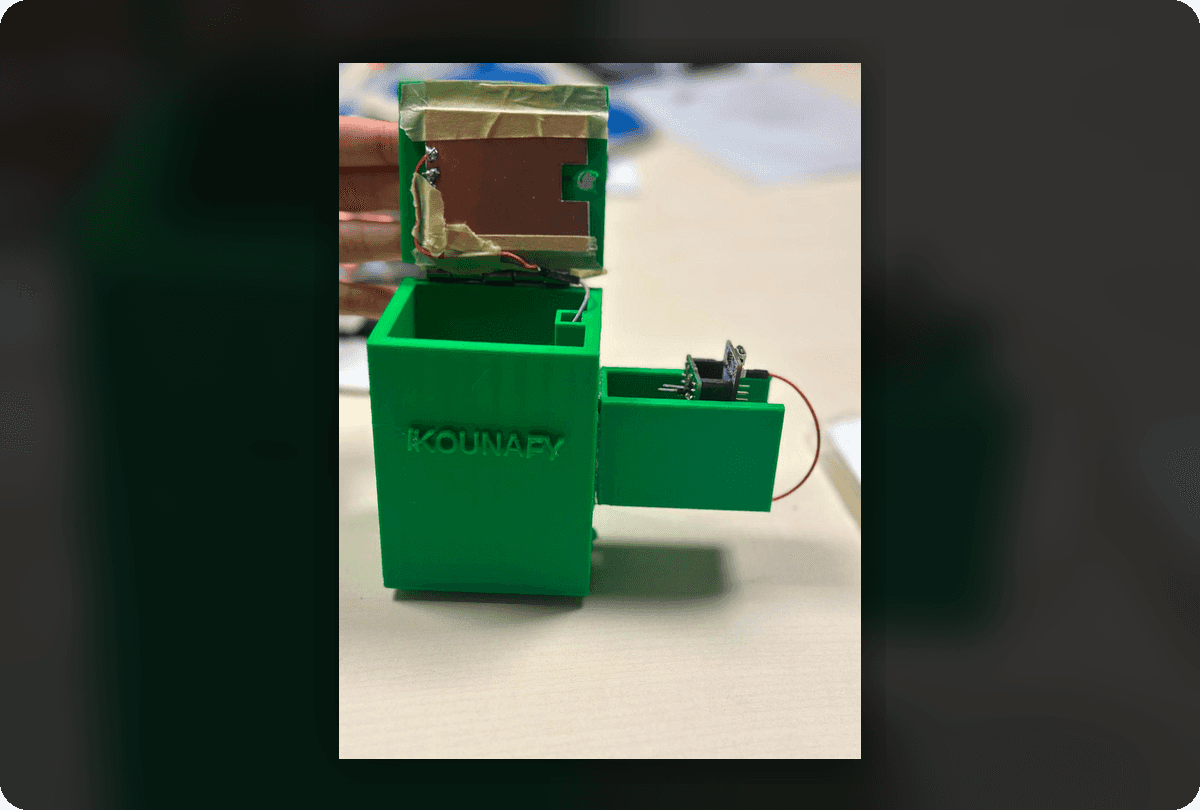
Pilleasy — Connected Medication Dispenser

Category:
Connected Health Device
Design Duration:
3 weeks
Pilleasy
A connected pill dispenser and companion app designed to improve medication adherence through secure dispensing, smart reminders and caregiver support.
Problem
According to the World Health Organization, nearly half of patients with chronic diseases do not take their medication as prescribed. Pilleasy was designed to simplify medication management while helping relatives and healthcare professionals detect missed doses before they become a recurring problem.
Design
Rather than building a simple reminder app, we designed a connected ecosystem combining a smart dispenser and a companion application. The dispenser only activates after a pharmacist validates the scanned prescription, while the app promotes long-term adherence through reminders, caregiver notifications and a gamified health avatar.
Technical Implementation
The STM32-based dispenser (developed by teammates) integrates fingerprint authentication, Bluetooth/Wi-Fi connectivity and a load-cell sensor intended to confirm that medication has actually been removed.
My contribution focused on developing the Flutter application. I designed four role-based interfaces (patient, family member, doctor and pharmacist), implemented prescription OCR, developed the reminder workflow and created the avatar system that encourages treatment adherence through positive feedback.
System Overview
STM32-based connected dispenser with fingerprint authentication
Flutter application with four role-based dashboards
Prescription OCR and pharmacist validation
Escalating reminder system for patients and caregivers
Gamified adherence tracking through a health avatar
Results & Limitations
Pilleasy received the Best Demo Prize at the Inov-Games competition.
The weight-based dose confirmation proved difficult to calibrate reliably and was not integrated into the final demonstration. Pharmacist validation also remains simulated within the application rather than connected to a production backend. My work focused exclusively on the application layer, while the embedded hardware was developed by other members of our six-person team.
Takeaways
Pilleasy showed me how embedded systems extend far beyond firmware alone. Building the application layer required understanding the needs of patients, caregivers and healthcare professionals while integrating seamlessly with an embedded device. It also reinforced the importance of making pragmatic engineering decisions: delivering a reliable prototype is often more valuable than demonstrating unfinished features.