Ikounafy SmartBin — Capacitive Fill-Level Sensing
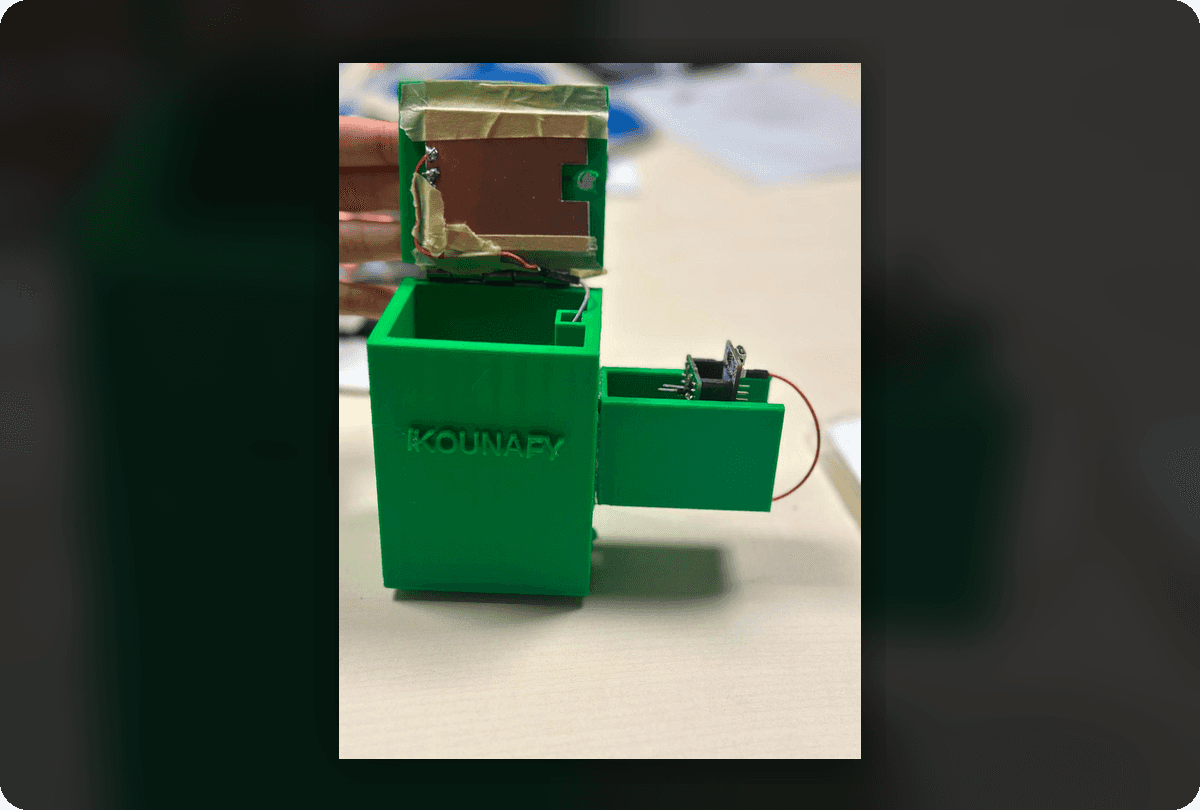
Category:
IoT
Design Duration:
6 weeks
Ikounafy SmartBin
A capacitive sensing system that turns a waste bin into a connected data source for smarter waste collection.
Problem
Waste collection often suffers from a lack of visibility rather than a lack of infrastructure. Ikounafy addresses a simple question: what if a waste bin could report its own fill level before a truck is dispatched?
Design
Instead of using ultrasonic sensors or probes in contact with the waste, we designed the bin itself as a capacitor. As the bin fills, the dielectric properties of the waste modify its capacitance, providing an indirect measurement of the fill level.
Challenges
Two main challenges emerged:
Different waste types have different dielectric properties, making calibration material-dependent.
The sensing range was limited by the electric field generated by the electrodes, leaving room for hardware improvements.
Technical Implementation
The sensing principle was first validated in COMSOL Multiphysics before designing the hardware.
A custom analog front-end, designed in KiCad around an ADA4622-based relaxation oscillator, converts capacitance variations into a frequency measured by an STM32F301K8 using Timer Input Capture. The firmware averages 30 samples, estimates the fill level and sends the data over UART to a Python gateway, which forwards it to a cloud dashboard through a REST API.
System Overview
Custom capacitive sensor integrated into the bin
KiCad analog conditioning circuit
STM32F301K8 firmware (Timer Input Capture, filtering, calibration)
Python gateway
Real-time monitoring dashboard
Results & Limitations
The complete sensing chain, from COMSOL simulation to real-time visualization, was successfully demonstrated.
Current limitations include waste-specific calibration, USB power, the need for a PC gateway and a sensing range that must be extended before deployment on full-size bins.
Takeaways
Ikounafy was my first end-to-end embedded systems project, combining physics simulation, analog electronics, embedded firmware and software into a complete sensing solution. While still a proof of concept, it validated the feasibility of low-cost capacitive fill-level sensing and highlighted the engineering challenges required for real-world deployment.

